What’s Actually Happening in Search
Search is still doing the same core job it always has. Helping people find useful information.
What has changed is how that information is presented.
Instead of sending every user to a list of links, search engines now sometimes generate direct answers. These answers summarize information, explain concepts, or compare options before a user ever clicks through to a website. Google’s AI Overviews are the most visible example, but they are not the only place this is happening.
This shift is why terms like Generative Engine Optimization, often shortened to GEO, have started to circulate.
GEO is not a new ranking system. It is not a replacement for SEO. It is simply a way to describe visibility inside AI generated answers rather than traditional search listings.
That distinction matters.
AI answers sit on top of the existing search ecosystem. They rely on indexed content, established sources, and signals of trust that were already in place. The difference is that instead of ranking pages, the system is selecting information to summarize or reference.
This has led to understandable questions.
- Why do some pages get cited while others do not?
- Why does an answer appear for one query but not another?
- What role does SEO still play when the answer is already on the page?
Those questions are reasonable. They also tend to get answered poorly when framed around fear or urgency.
The goal of GEO is not to chase AI features. It is to understand how AI answers are assembled and what makes content usable in that context. Once that mental model is clear, the rest of the conversation becomes much more practical.
How AI Answers Work at a High Level
AI generated answers can feel opaque, but the underlying process is simpler than it looks.
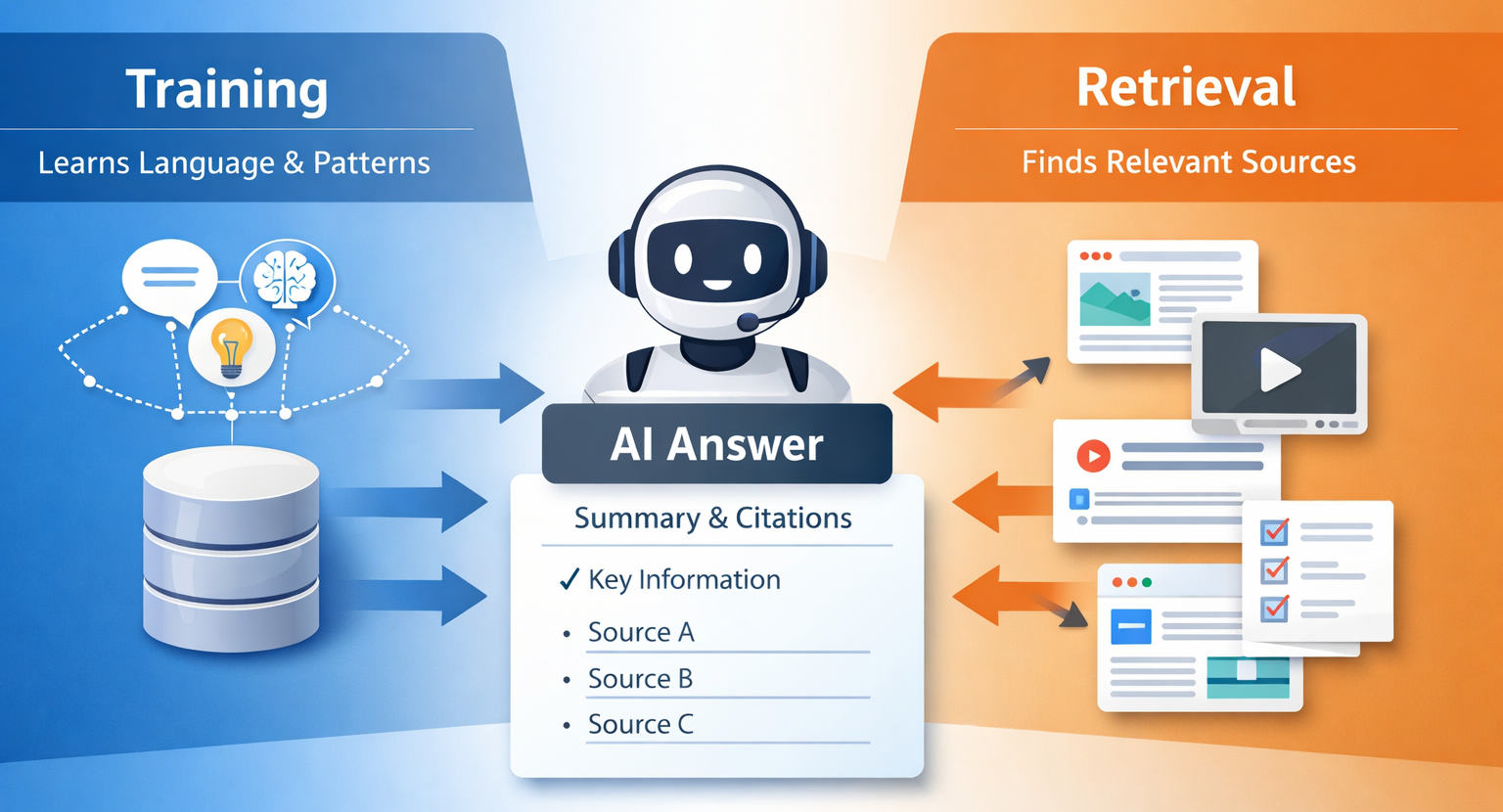
Most modern search systems rely on two distinct stages when producing an answer.
The first is training. During training, the model learns language patterns, relationships between concepts, and how ideas tend to be explained. This is how it knows what a question means and how to structure a response.
The second stage is retrieval. When a real query is entered, the system looks for external information that can support an answer. This is where indexed web pages, trusted sources, and structured content come into play.
This distinction matters more than most GEO discussions acknowledge.
Your website is not being trained into the model. Publishing content does not teach the system new facts in real time. Instead, your content becomes eligible to be retrieved if it clearly matches the question being answered and meets basic trust expectations.
When an AI Overview includes citations, those sources are usually pulled from this retrieval step. The system is looking for material that explains the topic directly, uses consistent terminology, and supports the response it is generating.
This is also why results can feel inconsistent.
Some queries trigger AI answers and others do not. Some answers cite multiple sources while others cite none. These systems are constantly testing when an AI response adds value versus when traditional results are sufficient.
The important takeaway is this.
GEO is not about influencing how the model thinks. It is about making your content easy to retrieve, easy to understand, and easy to support when an answer is being assembled.
Once you understand that, citation behavior starts to feel less mysterious and more predictable.
Why Some Pages Get Cited and Most Don’t
One of the most common questions around GEO is why certain pages appear as cited sources in AI answers while most never do.
The assumption is usually that citations are awarded based on authority alone. Authority matters, but it is not the deciding factor. AI systems are not trying to reward the best website. They are trying to assemble a usable answer.
That difference changes how content is evaluated.
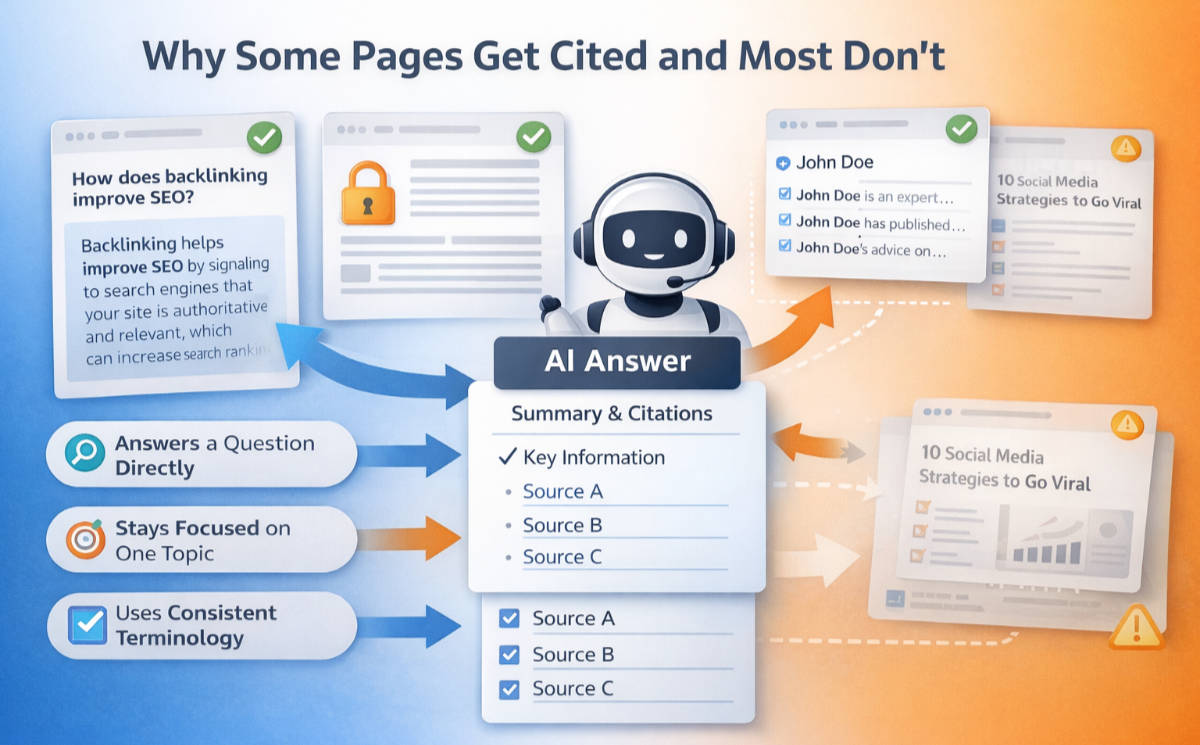
Pages that get cited tend to share a few traits that make them easy to work with during answer generation.
First, they answer a specific question directly.
AI systems favor content that resolves a question quickly and clearly. Pages that explain one concept cleanly are easier to extract from than pages that cover several related ideas without fully answering any of them. If the answer has to be inferred or pieced together, the page becomes less useful in a retrieval context.
Second, they stay focused on one topic.
Topical focus matters more for AI answers than it does for traditional rankings. A page that is clearly about one idea, process, or definition is easier to evaluate and easier to reference. Pages that mix multiple intents can still rank well, but they are harder to summarize accurately.
Third, they use consistent terminology.
AI systems rely on language patterns and entity relationships. When the same concept is described using vague phrasing or inconsistent names, it introduces ambiguity. Pages that use clear, stable terminology reduce that ambiguity and are easier to trust as supporting sources.
This explains why some well-ranking pages never get cited.
Strong rankings reflect relevance and authority. Citations reflect how easily information can be isolated and reused inside an answer.
When you view it this way, citation behavior becomes more predictable. It reflects how understandable and extractable your content is, not how aggressively it was optimized.
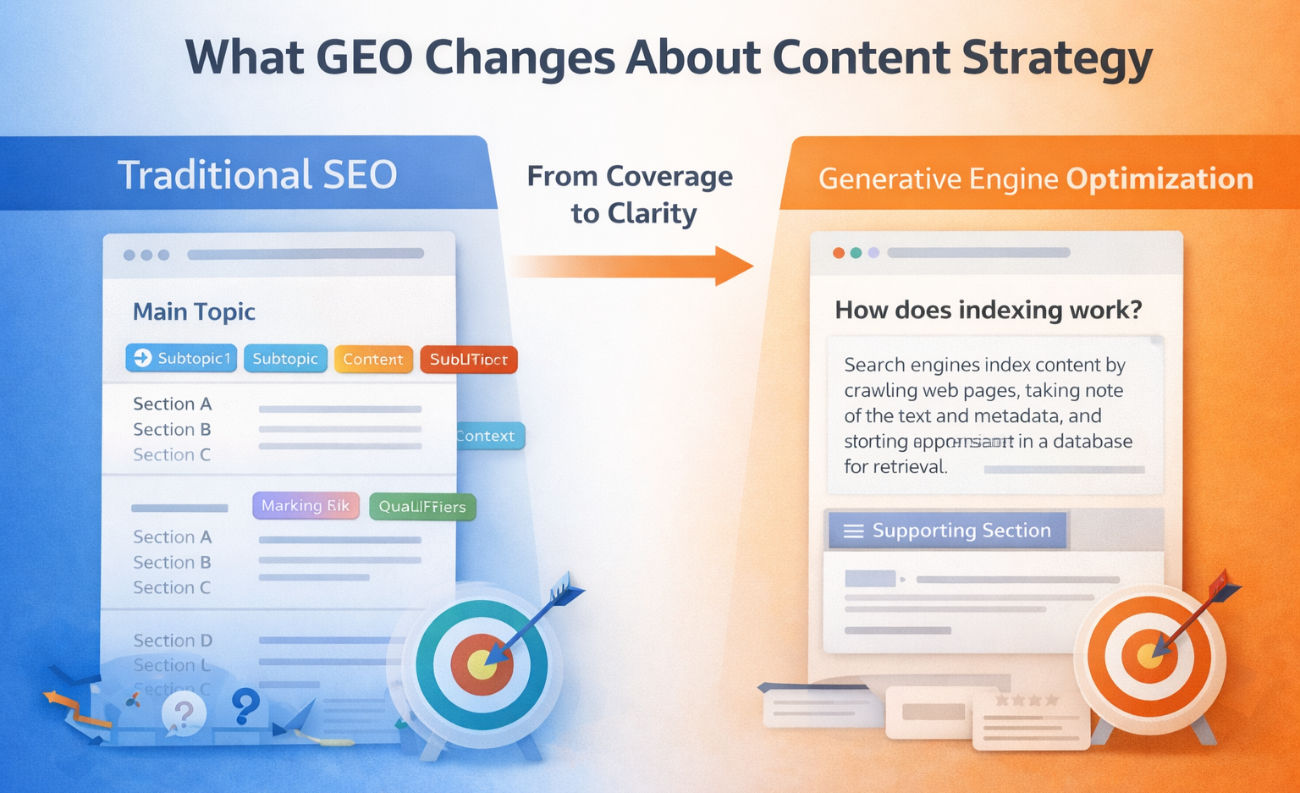
What GEO Changes About Content Strategy
The biggest shift GEO introduces is not technical. It is strategic.
Traditional SEO rewarded breadth. Pages were often designed to rank for a wide set of related keywords, cover multiple subtopics, and capture as much surface area as possible. That approach still works for rankings, but it does not translate cleanly to AI generated answers.
AI systems are not trying to understand everything on a page. They are trying to resolve a specific question.
From Coverage to Clarity
This change alters how content needs to be planned.
Content that performs well in a GEO context is usually built around clear intent. Each section answers one question. Each page has a primary purpose. Supporting information exists to clarify the answer, not to expand reach.
This is where many content strategies start to break down.
Pages written to rank for multiple intents often bury their best explanations under context, qualifiers, and marketing language. A human reader may eventually find the answer, but an AI system has less patience. If the answer is not obvious, it is less likely to be used.
GEO favors an answer-first approach.
That does not mean writing short or shallow content. It means structuring content so that the core explanation is easy to locate, easy to understand, and easy to support.
In practical terms, this often leads to a few strategic adjustments.
Content plans shift from “what keywords should this page rank for” to “what question should this page answer.”
Long pages get broken into more focused supporting pages.
Headings become more literal and less creative.
None of this replaces SEO fundamentals. It refines them.
Pages still need context. They still benefit from internal linking. They still need to establish trust and accuracy. The difference is that clarity becomes the primary optimization goal instead of coverage.
When content is designed this way, it tends to perform better for humans and AI systems at the same time. That overlap is where GEO fits most naturally.
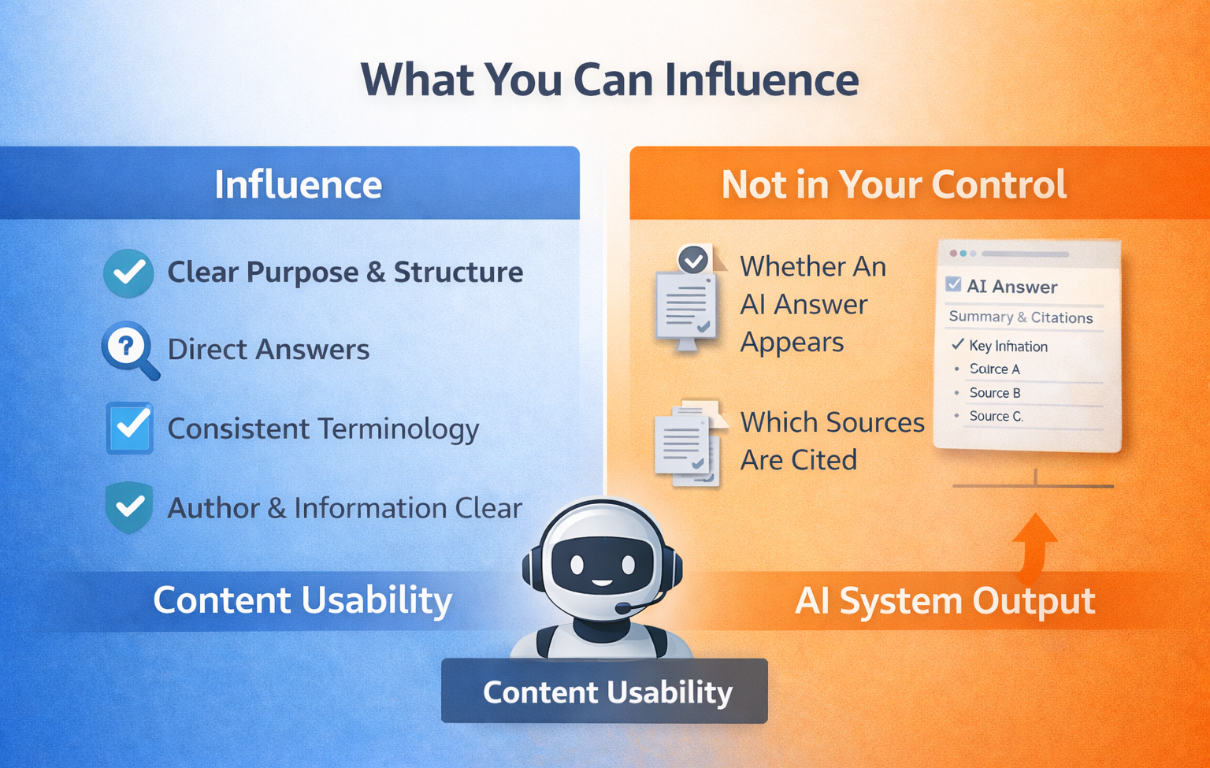
What You Can Influence With GEO
GEO works best when you separate what you can influence from what you cannot.
You do not control when an AI answer appears or which sources are cited. What you can influence is whether your content is usable if it is considered.
Focus on Usability, Not Control
That starts with purpose.
Pages that make their intent clear early are easier for AI systems to evaluate. When a page explains what it is about, what question it answers, and how it is structured within the first few sections, it becomes easier to trust as a source. Ambiguity works against retrieval.
Structure reinforces that clarity.
Content organized around clear sections, each focused on a single idea, gives AI systems natural places to extract information. Headings that reflect real questions or plain descriptions signal relevance more effectively than clever or abstract phrasing.
Consistency matters in quieter ways.
Using stable terminology for the same concepts reduces uncertainty. This includes how you name products, define processes, and describe roles or entities. When language shifts unnecessarily, it introduces friction that makes extraction less reliable.
Credibility Signals Still Matter
Trust is not ignored in AI generated answers. It is just evaluated differently.
Clear authorship, accurate claims, and content that reflects current understanding all contribute to credibility. These signals help establish whether a page is safe to reference, even if they do not guarantee inclusion.
What tends to hurt more than a lack of authority is uncertainty. Outdated information, unclear sourcing, or vague claims make a page easier to exclude when alternatives exist.
It is important to be clear about what this is not.
This is not about formatting tricks or optimizing for machines. It is not about adding layers of markup or rewriting content to sound artificial. These changes improve human understanding first. The fact that they also help AI systems is a secondary benefit.
When content is genuinely easy for a person to understand and trust, it is usually easier for an AI system to work with. That overlap is where influence exists.
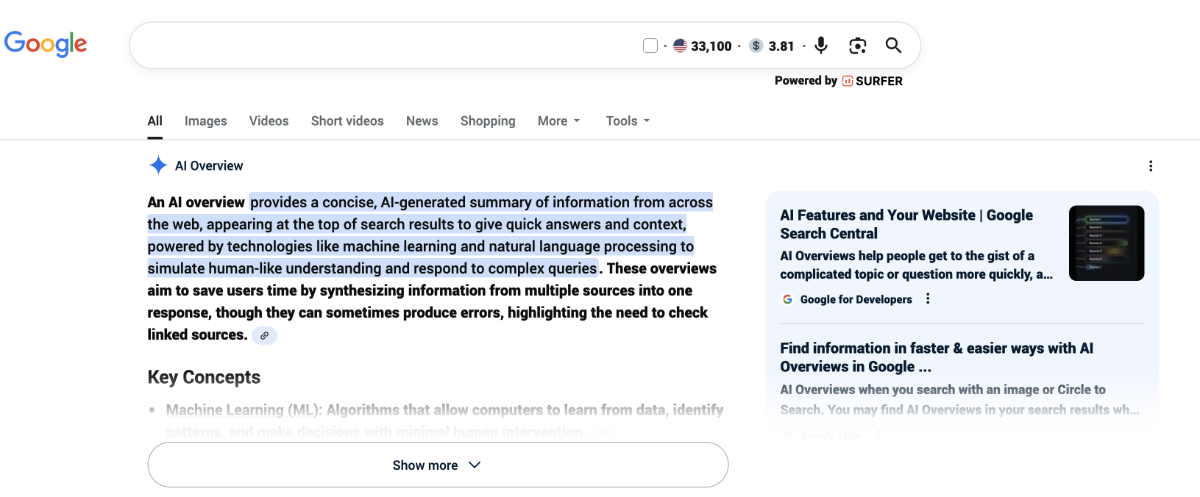
What You Cannot Control in GEO and AI Overviews
One of the fastest ways to waste time with GEO is assuming it behaves like traditional SEO.
It does not.
AI generated answers introduce uncertainty by design. Understanding what sits outside your control helps prevent over-optimization and keeps effort focused where it actually matters.
When AI Overviews Appear in Search Results
You cannot decide when an AI answer shows up. Some queries trigger AI Overviews consistently. Others never do. Many fluctuate over time. This is not a reflection of content quality alone. It is the result of ongoing testing around intent, usefulness, and risk.
Factors outside your control include:
- Whether a query is considered suitable for an AI generated response
- How confident the system is in available sources
- Whether a traditional result is deemed sufficient
Even well written, highly relevant content may never be surfaced if the system decides an AI answer does not add value for that query.
This is why GEO should never be treated as a requirement for every page.
How Citations Change Over Time
Citations are not permanent. AI systems test different sources, rotate references, and adjust based on performance signals. A page that is cited today may disappear tomorrow and reappear later without any change on your end. This does not mean something broke. It reflects how retrieval systems experiment to improve answer quality. The goal is not consistency for publishers. The goal is usefulness for users.
Because of this, GEO visibility should be treated as probabilistic, not guaranteed.
Differences Between AI Search Engines and Systems
Another common mistake is assuming all AI driven search experiences work the same way. They do not. Different engines use different retrieval methods, apply different trust thresholds, and favor different source types. What works well in one environment may not translate directly to another.
This is why chasing individual citations or reverse engineering specific answers rarely holds up over time. The healthiest mindset is to accept uncertainty as part of the system. You control how clear, focused, and credible your content is. You do not control how often it is selected, how long it stays visible, or where it appears.
Recognizing that boundary is not limiting. It is freeing. It allows GEO to be treated as a secondary benefit of good content decisions rather than a fragile target that constantly moves.
How GEO Fits Into Existing SEO Work
One of the most persistent misconceptions around GEO is that it requires a separate strategy from SEO.
It does not.
GEO is best understood as a visibility outcome that depends on strong SEO foundations. SEO determines whether your content is eligible to be considered. GEO determines whether that content is selected and reused inside an AI generated answer.
Seen this way, the relationship becomes much clearer.
Technical SEO Still Determines Eligibility
Before content can appear in an AI generated answer, it still has to be accessible.
Pages must be crawlable. They must be indexable. They must load reliably and communicate clear intent. If a page cannot be consistently retrieved and understood by a search engine, it cannot be reliably referenced by an AI system.
This is why technical SEO remains non-negotiable.
Clean site architecture, intentional internal linking, and clear page purposes all help establish eligibility. GEO does not bypass these requirements. It relies on them.
In practice, this means that fixing crawl issues, consolidating overlapping content, and reducing ambiguity in page intent continue to matter, even as the presentation layer of search evolves.
Authority and Content Quality Influence Selection
Once content is eligible, different factors come into play.
Authority, brand signals, and reputation help determine whether a source is safe to reference. Content quality helps determine whether it is useful once selected. Neither guarantees inclusion, but both influence selection behind the scenes.
This is where content quality becomes more precise.
Pages that explain topics clearly, use consistent terminology, and avoid unnecessary padding are easier to support inside an AI answer. Pages that rely on vague claims or broad coverage are harder to extract from, even if they rank well.
The practical takeaway is simple.
Strong SEO creates eligibility. Clear, focused content improves selection. Treating GEO as a separate workflow usually leads to duplicated effort and weaker outcomes.
When SEO fundamentals are solid and content is written to be understood rather than stretched, GEO visibility tends to follow naturally.
| SEO Foundation | What It Controls | How GEO Builds on It |
|---|---|---|
| Technical SEO | Crawlability, indexability, page access, and clear intent | Determines whether content can be retrieved and reused by AI systems |
| Site Structure & Internal Links | Context, hierarchy, and topical relationships | Helps AI understand page purpose and reduce ambiguity |
| Authority & Brand Signals | Trust, reputation, and source reliability | Influences whether a source is considered safe to reference |
| Content Quality | Clarity, accuracy, and usefulness for users | Improves how easily information can be extracted into AI answers |
Practical Guidance Without Overpromising
Once GEO is understood as a byproduct of good SEO and clear content, the question becomes practical. What should you actually do differently. The answer is less dramatic than most advice makes it sound. You do not need a new playbook. You need better discipline around how content is written, structured, and maintained.
Start With Pages You Already Have
The easiest place to apply GEO thinking is not new content. It is existing pages that already receive impressions, traffic, or rankings.
These pages already meet basic eligibility requirements. The work is in making them easier to understand and easier to extract from.
In many cases, small changes make a difference:
-
Clarify what the page is about in the opening section
-
Add direct answers to obvious questions the page implies but never states
-
Tighten headings so they describe what follows instead of teasing it
-
Remove sections that exist only to pad coverage
This is not optimization for AI. It is cleanup for humans that happens to align with how AI systems work.
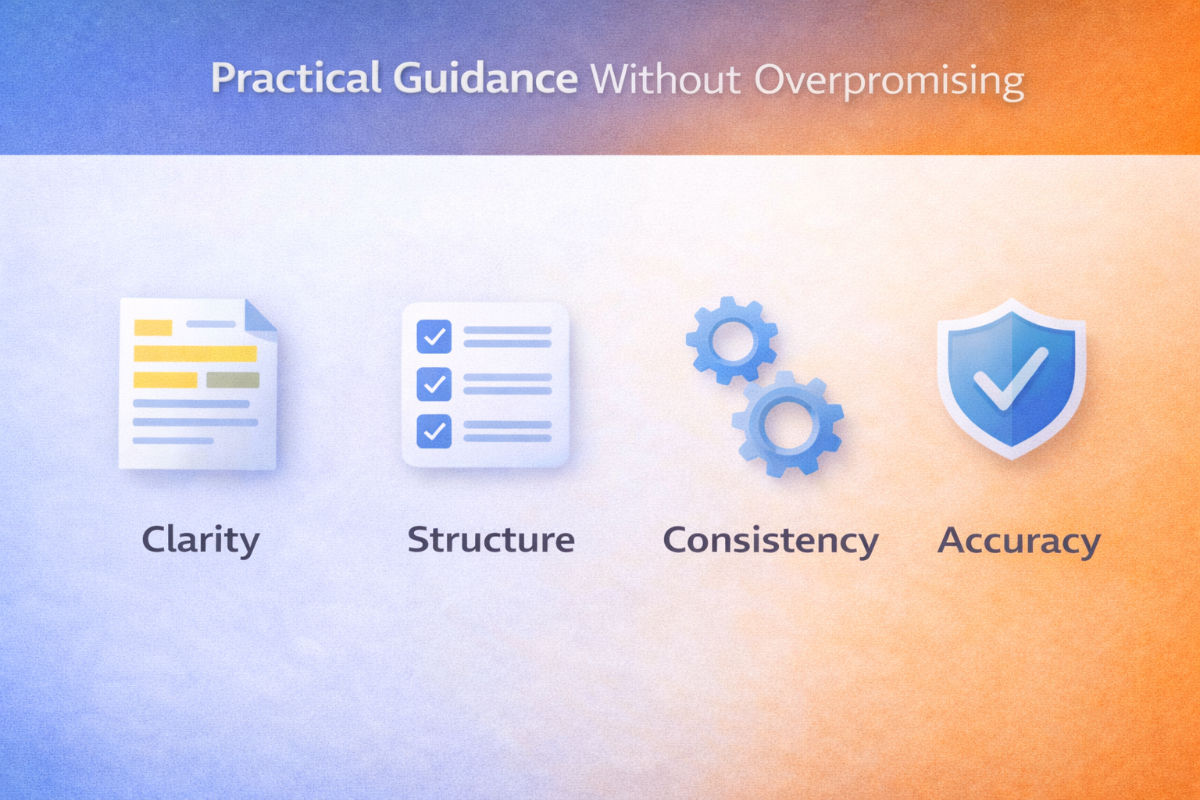
Write Answers Before Explanations
One pattern that consistently aligns with AI answers is answer-first structure. Instead of building toward a conclusion, state the conclusion clearly and then explain it. This makes the core idea visible immediately, both to readers and to retrieval systems. This does not mean oversimplifying. It means separating the answer from the supporting context.
Pages that do this well tend to be easier to summarize, easier to quote, and easier to reference.
Treat GEO as a Secondary Signal, Not a KPI
Perhaps the most important guidance is what not to measure too aggressively.
GEO visibility should not become a primary KPI. It is too volatile, too opaque, and too dependent on factors outside your control.
A more sustainable approach is to focus on inputs you can evaluate reliably:
-
Are pages answering clear questions
-
Is terminology consistent across related content
-
Is the page purpose obvious without scrolling
-
Would a knowledgeable reader trust this explanation
If those answers are yes, you are doing the work that GEO rewards, even if the outcome is not immediately visible. The moment GEO becomes something you chase directly, it stops being useful. When it is treated as a side effect of clarity and quality, it tends to show up where it makes sense.
How to Think About GEO Going Forward
GEO feels new because the interface of search is changing. The underlying problem is not.
People still want clear answers. Search engines still want reliable sources. The difference is that the explanation layer now sits closer to the user.
That makes clarity more visible.
Clarity Is the Durable Advantage
The safest way to think about GEO is not as a tactic, a channel, or a system to chase. It is a reflection of how understandable your content is when someone or something needs to explain it.
AI systems surface content that reduces uncertainty. They favor explanations that can stand on their own, use consistent language, and do not require interpretation. That preference aligns closely with what good content has always looked like, even before AI answers existed.
This is why short term tricks do not age well in this space.
Prompt hacks, formatting gimmicks, and over-optimized templates tend to break as systems evolve. Clear explanations tend to survive. Pages written to genuinely help someone understand a topic tend to remain useful, even as the presentation layer changes.
The most productive long term approach is to treat GEO as feedback.
If your content is hard for an AI system to summarize, it is often hard for a reader to understand. If it is easy to extract, it is usually easy to trust.
That is not a coincidence.
GEO does not require you to predict how search will look next year. It rewards doing the basics well today and doing them consistently. When content is written to explain rather than perform, visibility tends to follow in whatever format search takes next.
That is the mindset that scales.
FAQs About Generative Engine Optimization
What is Generative Engine Optimization (GEO)?
Generative Engine Optimization refers to how content is selected, summarized, or cited inside AI generated answers. It is not a ranking system or a separate platform. It describes a visibility outcome when search engines explain answers instead of listing links.
How is GEO different from traditional SEO?
SEO focuses on helping pages rank and earn clicks. GEO focuses on whether information is clear, focused, and trustworthy enough to be used inside an AI generated answer. GEO builds on SEO rather than replacing it.
What are AI Overviews in Google Search?
AI Overviews are Google’s AI generated summaries that appear for some informational queries. They attempt to answer the question directly using generated text and, in some cases, cited sources from the web.
Can I optimize content specifically for AI Overviews?
You cannot force inclusion in AI Overviews. What you can do is improve clarity, structure, and consistency so content is easier to extract and trust if it is considered. These changes also benefit human readers.
Why do AI citations appear and disappear?
Citations change because AI systems test different sources and adjust based on usefulness and confidence. This behavior is expected. Visibility inside AI answers is probabilistic rather than permanent.
Should GEO be a primary SEO KPI?
No. GEO visibility is too volatile to track as a core metric. It is better treated as a secondary signal that reflects strong SEO fundamentals and clear content rather than something to chase directly.