Google’s AI Overviews are changing how content gets seen and used. Instead of linking out to a single source, these summaries pull structured answers from multiple pages and piece together a complete response directly in the search result.
If your content isn’t optimized for this kind of visibility, it won’t get cited, and it likely won’t be surfaced at all.
This resource breaks down the key content formats we’ve seen appear most frequently in AI Overviews. Each format includes a short explanation and practical tips for structuring your pages in a way that helps Google’s AI extract, understand, and reuse your content.
Why GEO Is Becoming a Big Deal in SEO
Search is changing. Google isn’t just linking to websites anymore, it’s answering questions directly on the results page. These AI-generated answers are what Google calls AI Overviews, and they’re pulling content straight from websites, sometimes without sending traffic back.
That’s where Generative Engine Optimization (GEO) comes in. GEO is the process of optimizing your content to show up in these AI-generated responses. It’s still evolving, but smart marketers are already adjusting their strategies to match the way AI tools choose and summarize web content.
Ignoring GEO could mean losing visibility, even if you’re ranking high in traditional search. If your content isn’t showing up in these AI Overviews, someone else’s is. The focus now isn’t just about getting clicks, it’s about being the answer.
Content Structures That Help You Rank in AI Overviews
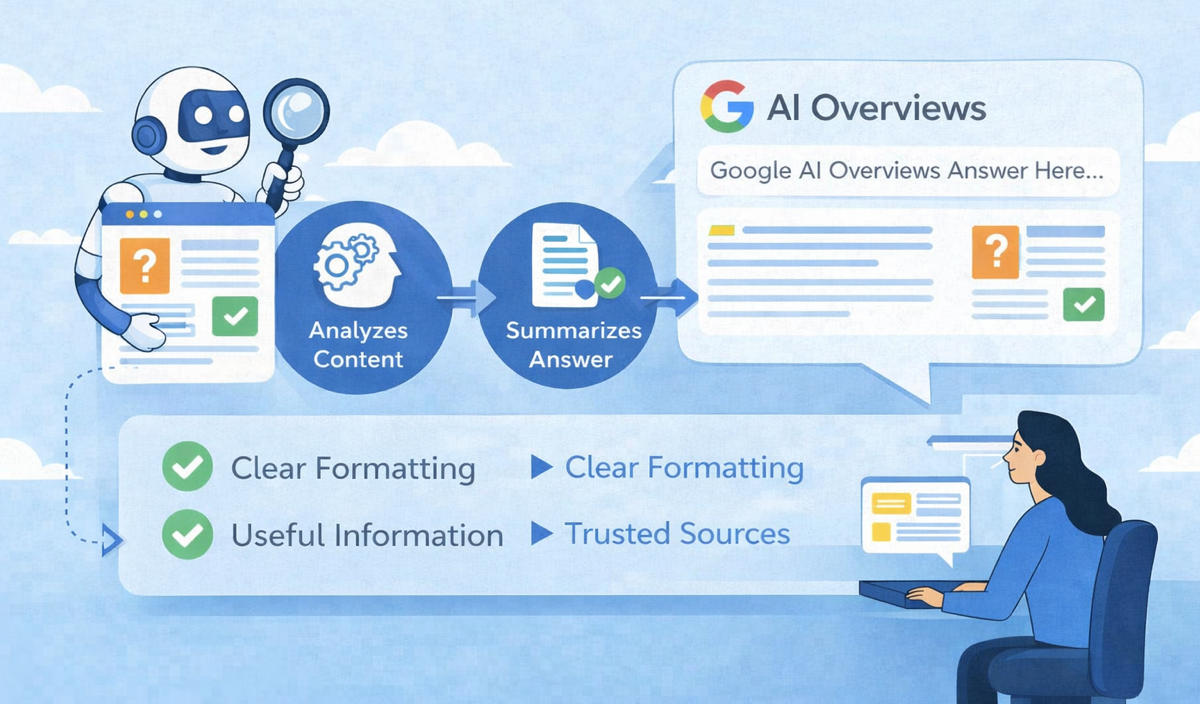
When it comes to showing up in Google’s AI Overviews, structure is everything. The way your content is organized plays a huge role in whether it gets picked up. Google’s generative engine scans pages looking for clear, scannable answers and some formats naturally stand out more than others.
These are the formats we’ve seen consistently surface in AI-generated responses:
- Direct answers – Short, clear sentences that immediately address the user’s question. No fluff.
- Bullet or numbered lists – Perfect for tutorials, comparisons, or breaking down pros and cons.
- Comparison tables – Easy for AI to scan and extract data when showing product or feature differences.
- Q&A blocks – A simple question followed by a one-paragraph answer works well.
- Mini how-tos – Three to five steps that walk the reader through a process quickly.
Using these formats helps Google understand your content faster and increases your odds of being featured. Think of it like packaging your answers in a way that’s ready-made for machine reading.
How to Optimize for AI Overviews Without Losing SEO Value
SEO fundamentals still matter, but to land in AI-generated results, your content needs extra polish. It’s not just about ranking anymore—it’s about being the answer.
Here’s how to prep your content:
- Start with a clear answer. Make your key point in the first sentence. No long windups.
- Keep it natural. Write how people speak and search. Conversational beats keyword-stuffed.
- Use clean formatting. Break up content with H2s, lists, short blocks, and tables.
- Think like the searcher. Add question-based headings that mirror real search behavior.
- Cover the topic fully. Don’t stop at one answer. Address related angles to build authority.
This is about making your content easy to quote and even easier to understand.
How to Structure Content for Better AI Visibility
If you want your content to show up in AI Overviews, structure matters just as much as substance. Google’s AI scans for information it can easily extract and summarize, so it helps to write with clear headings, tight paragraphs, and consistent formatting.
Here’s what to prioritize:
- Use H2 and H3 headings to break up your content by topic or subtopic.
- Keep paragraphs short, ideally under 3 lines, to make scanning easier.
- Place keywords near the start of sentences, especially in answer blocks or summaries.
- Use HTML tags properly so the AI can understand context (e.g. <ul>, <ol>, <table>, etc.).
- Include quick answers at the top of the page when possible.
This approach isn’t just good for AI visibility. It improves readability, which helps humans and algorithms alike figure out what your page is really about.

Why Keywords Still Matter in a GEO World
Even with AI generating answers, keyword optimization hasn’t lost its place. It just looks a little different. Instead of stuffing pages with exact-match phrases, the focus now is on clarity, relevance, and context. Google’s AI uses signals from headings, sentence structure, and supporting keywords to decide if your content fits the query.
To align with GEO principles:
- Use natural language that mirrors the way people ask questions.
- Include related terms and variations to help AI connect the dots.
- Front-load your most important keywords in headings, subheadings, and answer blocks.
- Answer specific questions directly before expanding with more detail.
This kind of optimization still helps you rank in traditional results, but it also makes your content easier for AI to parse and quote. It’s not about gaming the system, it’s about helping it understand you faster.
How to Organize Keywords for Better SEO Insights
Once you’ve gathered a strong list of keywords, the real power comes from how you organize them. A scattered list won’t get you far. Grouping keywords by topic, intent, and funnel stage helps you write content that ranks and converts.
Try organizing your keyword list in these ways:
- Topic or Theme – Cluster similar keywords together. If you’re targeting “seo tools,” group terms like “best seo tools,” “free seo tools,” and “seo software” under one bucket.
- By Search Intent – Separate keywords into informational, navigational, and transactional. This helps tailor your content to match what users actually want.
- By Funnel Stage – Awareness, consideration, and decision-stage keywords should guide what type of page or blog you create.
- By Page Type – Use filters to decide which keywords belong to blog posts, service pages, or product pages.
Label everything. Use columns in your sheet to tag each keyword by topic, intent, page type, and search volume. This gives you a roadmap to create content that hits all the right angles.
| Keyword | Topic | Intent | Funnel Stage | Page Type |
|---|---|---|---|---|
| best seo tools | SEO Tools | Transactional | Consideration | Blog Post |
| what is keyword research | Keyword Research | Informational | Awareness | Blog Post |
| seo audit service | SEO Services | Transactional | Decision | Service Page |
| free keyword planner | Keyword Tools | Navigational | Consideration | Tool Page |
How Keyword Organization Informs AI-Visible Content
Organizing keywords is not just about planning pages. It directly shapes how your content is structured and how easily Google’s AI can understand and reuse it.
When keywords are grouped by topic and intent, they define the natural scope of a page. Instead of chasing individual terms, you end up creating content that explains a subject fully. That matters because AI Overviews tend to pull from pages that cover a topic cleanly, not from pages built around a single phrase.
Well-organized keyword clusters help in a few key ways:
-
Clarify page intent
Grouped informational keywords lead to pages that explain, which aligns well with AI-generated answers. -
Create predictable structure
Primary keywords map to the main topic, while related terms become section headings and supporting explanations. -
Encourage coverage over repetition
Treating keywords as signals helps expand the topic instead of restating the same idea in different words.
In practice, keyword organization becomes a blueprint for clarity. It keeps each page focused, complete, and easier for both readers and AI systems to interpret and reuse.
Content Structures AI Overviews Prefer
Once page intent is clear, structure becomes the main factor in whether content can be reused in AI Overviews. Google’s AI looks for information that is clearly segmented, easy to extract, and safe to summarize.
The structures that appear most often share a few traits:
Answer-First Sections
State the answer in the first sentence, then explain. This works well for definitions and direct questions where the core idea should stand on its own.
Clearly Scoped Subsections
Each section should focus on one idea. Clean separation helps AI understand where concepts begin and end.
Purposeful Lists
Lists perform best when they separate ideas or steps. Short lists that add meaning are reused more often than long or repetitive ones.
Structured Comparisons
Tables and side-by-side contrasts reduce interpretation. These formats are commonly used when a query involves differences or choices.
Question-and-Answer Blocks
A clear question followed by a short, complete answer creates a self-contained unit that can be reused without extra context.
Real-World Patterns From Pages That Get Cited
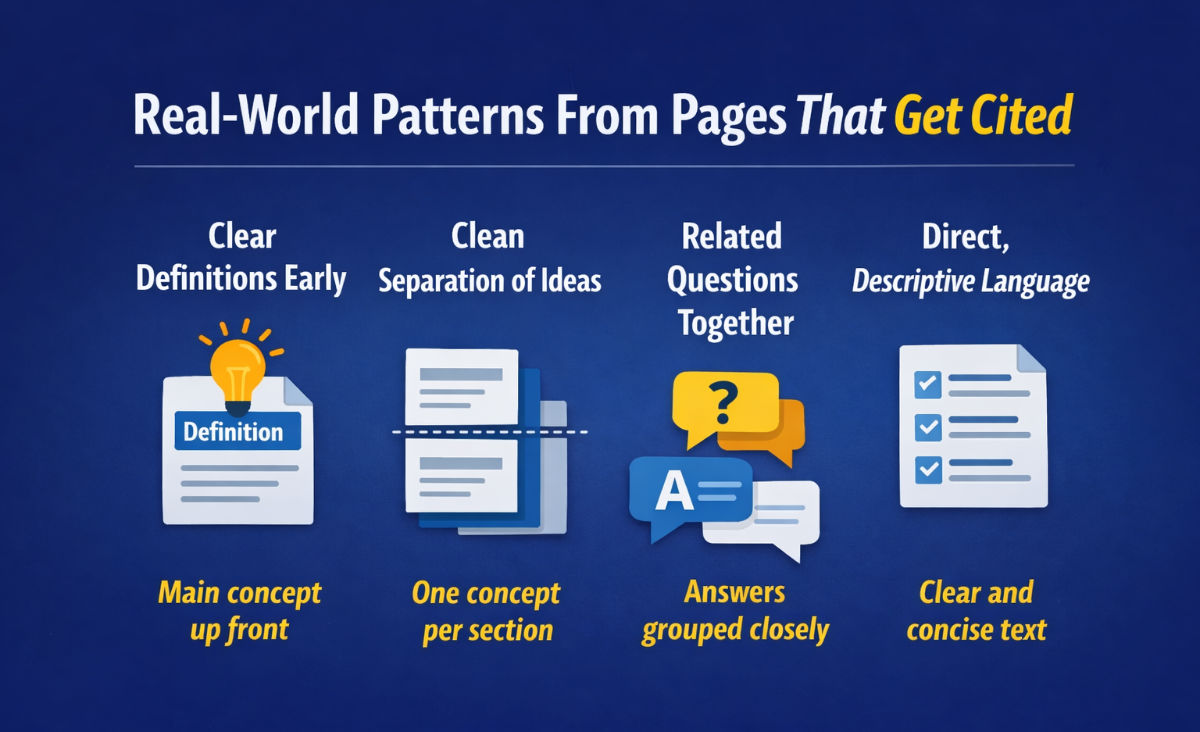
Pages that surface in AI Overviews tend to follow a few consistent patterns. These are not tactics. They are signals of clarity.
Common traits include:
-
Clear definitions early
The main concept is stated up front before supporting detail is added. -
Clean separation of ideas
Each section focuses on one concept, making boundaries easy to interpret. -
Related questions answered together
Supporting explanations live near the main answer instead of being scattered. -
Direct, descriptive language
The writing prioritizes explanation over creativity or persuasion.
These patterns reduce ambiguity and make content easier for AI systems to extract and reuse.
Common Mistakes That Prevent AI Overview Visibility
Most pages that miss AI Overviews do not fail because of a lack of keywords or authority. They fail because their information is harder to interpret and reuse.
The issues below show up repeatedly.
-
Burying the answer
Long introductions delay the main point. If the core idea is not clear early, AI systems may skip the page entirely. -
Combining multiple ideas in one section
When paragraphs try to explain several concepts at once, boundaries blur. This makes extraction unreliable. -
Writing headings for keywords instead of meaning
Headings that prioritize phrasing over clarity often misrepresent what the section actually explains. -
Over-formatting without purpose
Lists, tables, and FAQs used as decoration rather than structure add noise instead of clarity. -
Treating AI Overviews as a separate tactic
Pages built specifically “for AI” often ignore basic information architecture. This usually makes them worse, not better.
These mistakes are subtle, but they all create the same problem. They introduce ambiguity. AI Overviews favor pages that reduce interpretation, not pages that try to outsmart the system.
Final Perspective: Clarity Wins Regardless of the Interface
AI Overviews have changed how information is delivered, but they have not changed what search engines consider useful. Pages that explain clearly, separate ideas cleanly, and address topics with intent are still the pages being reused.
What AI Overviews expose more clearly than traditional rankings is where content falls apart. Vague sections, overloaded paragraphs, and unclear intent were always weaknesses. AI systems simply make those weaknesses more visible by skipping over content they cannot confidently interpret.
Optimizing for AI visibility is not about chasing a new system or rewriting everything from scratch. It is about reducing friction between what a page is trying to explain and how that explanation is structured. When information is easy to isolate and understand, it becomes easier to reuse, quote, and trust.
This is why many of the recommendations in this article feel familiar. They are extensions of good information design, not a departure from it. Clear answers, logical structure, and complete topic coverage tend to perform well regardless of how search results are presented.
The interface may continue to change, but clear thinking, clear structure, and clear answers will always be the easiest thing for both people and machines to say yes to.