
How to Measure SEO Wins When Clicks Drop but Visibility Still Climbs
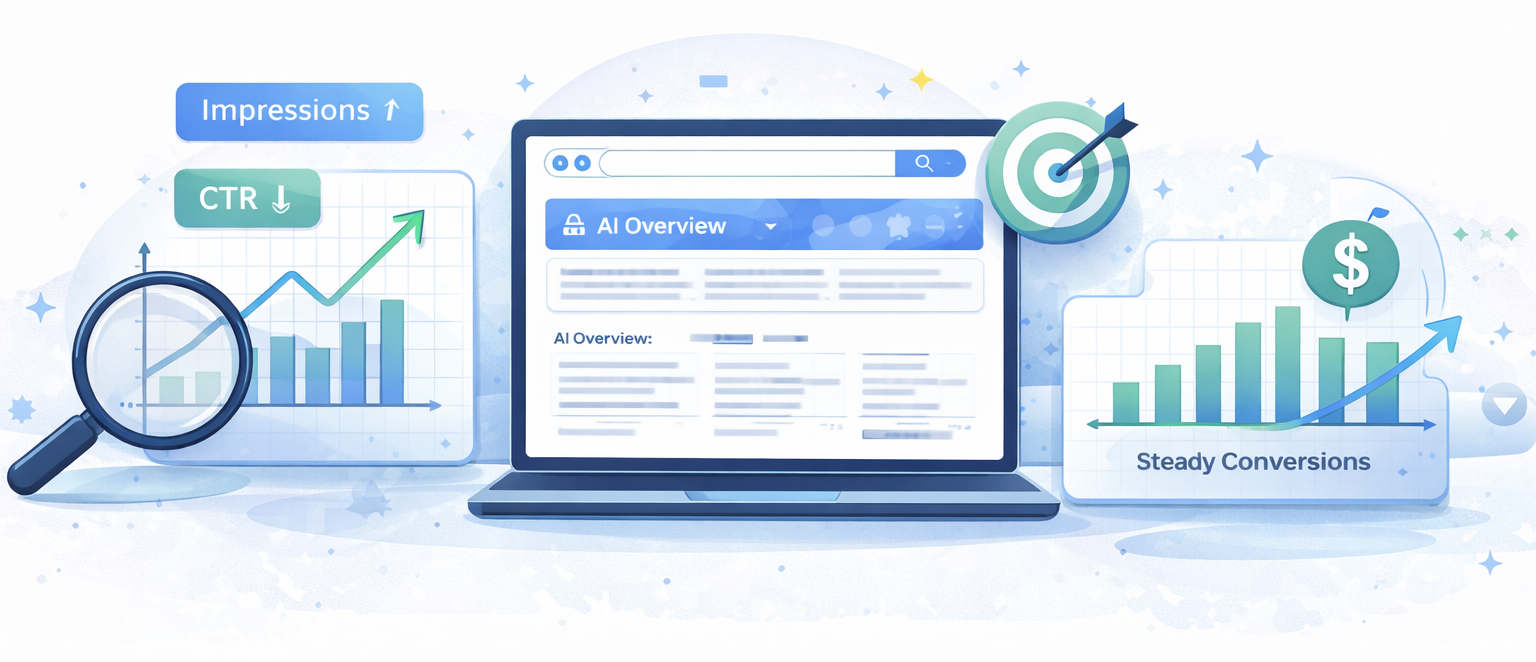
SEO dashboards are telling a strange story lately. Impressions are rising. Clicks are falling. CTR is trending down. Rankings often look stable or improved, yet organic traffic feels softer and performance questions start piling up.
That gap is unsettling because it breaks a long-held assumption. For years, stable rankings and growing impressions usually meant more traffic. AI Overviews have changed that relationship. Users are still seeing and consuming content, but they are clicking less often, especially on informational queries.
This does not mean SEO stopped working. It means how impact shows up has changed. The problem is not relevance. It is measurement.
This article explains what changed in search behavior, what did not change about SEO fundamentals, and how to measure success in 2026 without relying on outdated assumptions.
TL;DR
-
AI Overviews increase impressions without guaranteeing clicks
-
CTR drops do not automatically signal declining performance
-
Visibility now often happens before the click, not at it
-
SEO success in 2026 requires measuring influence, not just traffic
What “Zero Click” Actually Means in 2026
Zero-click searches are not new, but their impact looks different now.
In simple terms, a zero-click search happens when a user gets what they need directly on the results page and never visits a website. In 2026, this is most visible through AI Overviews, featured snippets, and expanded SERP answers that summarize information upfront.
What matters is this. Zero click does not mean zero influence. It means the interaction moved earlier in the journey. The user still saw your brand, your framing, or your explanation. The click just was not required to satisfy the immediate question.
This shift hits informational and exploratory queries first. Questions like definitions, comparisons, how-to guidance, and early research are now often answered before a user ever considers clicking. That is why many teams see impressions climb while clicks flatten or fall.
A helpful way to think about zero click in 2026:
- Discovery still happens in search
- Consumption often happens on the SERP
- Action happens later, sometimes on a different query or session
This is why “impressions up, clicks down” is showing up across industries, not just content-heavy sites. Search behavior has changed faster than reporting expectations.
The key takeaway is grounding. Zero click reflects how answers are delivered, not whether your content is valued. Understanding that distinction is what allows the rest of your measurement strategy to make sense.
How Google Counts AI Overviews in Search Console
One of the biggest sources of confusion is how AI Overviews are counted in Search Console.
AI Overview exposure isn’t broken out separately. Those impressions and clicks are merged into standard performance reports alongside traditional organic results, making them indistinguishable.
This explains why impressions often rise while clicks don’t. When your content appears in an AI Overview, Google counts it as an impression. But if users get their answer without clicking, no session occurs, resulting in a sudden, seemingly unexplained CTR decline.
This is not a ranking issue. It is a math issue.
When AI-driven exposure increases, the denominator grows faster than the numerator. CTR drops, even when relevance and visibility improve. In many cases, the appearance of underperformance is a measurement artifact, not a signal that content quality declined.
What Search Console still does well:
- Shows query-level visibility and impression growth
- Reflects changes in average position over time
- Surfaces which topics are being seen more often
Where it falls short today:
- No clear separation between AI Overview exposure and traditional results
- No indication of whether an impression came from citation, summary, or standard listing
- Limited insight into post-exposure influence
The takeaway is practical. Search Console is still useful, but it cannot be read the same way it was before AI Overviews became common. Treat impressions as visibility signals, not implied traffic promises, and interpret CTR trends with SERP context in mind.
What This Looks Like in Real Accounts
Once you know how AI Overviews are counted, the patterns showing up in real data start to make sense.
The first pattern is common on informational pages. CTR declines, but assisted conversions remain steady. These pages appear more often, get seen more frequently, and influence decisions, even though fewer users click through immediately. The value shows up later, not at the first interaction.
The second pattern is broader. Impressions and average position increase while sessions flatten. Rankings improve, visibility expands, yet traffic plateaus.
This happens when AI Overviews satisfy early intent directly on the SERP, reducing the need for an immediate visit.
These trends are not isolated to a single industry or site type. They show up across SaaS, local services, ecommerce, and content-heavy brands. The common factor is not vertical. It is query intent.
What matters is framing. These patterns show how people use search today, not a failure of SEO principles.
Recognizing them as structural shifts instead of performance failures prevents teams from making reactive changes that solve the wrong problem.
What AI Overviews Change in the SERP
AI Overviews change where attention goes, not whether ranking still matters.
They appear high on the page and often occupy the space that used to belong to the first few organic results. On many informational queries, the overview becomes the primary focal point before users even scan traditional listings. That alone shifts how visibility is experienced.
This creates a new reality. Being ranked first does not guarantee being seen first. A page can hold a strong position and still receive less attention if the overview satisfies the immediate intent. The ranking is still there. The user’s need to click is not.
Another important shift is visual hierarchy. AI Overviews compress the visible SERP. Fewer organic results are shown above the fold, and more context is delivered before a scroll. That widens the gap between ranking position and actual visibility.
The result is subtle but consistent:
- Rankings remain stable
- Impressions increase
- Attention concentrates earlier on the page
This is why CTR declines can coexist with strong visibility. The SERP now does more of the explaining upfront. SEO performance is no longer just about where you rank, but where your content shows up in the flow of attention.
What AI Overviews Did Not Change
AI Overviews change how results are shown, not how they are ranked.
Google still evaluates pages based on relevance, clarity, and usefulness. Content that answers real questions well continues to earn visibility. Thin or unclear pages do not benefit simply because AI summaries exist.
Topical authority still holds. Sites that cover a subject with depth and consistency continue to surface across related queries. The difference is that more of that value is delivered before a click.
Commercial intent also remains strong. When users are ready to compare or act, they still click. AI Overviews have limited impact on high-intent queries that require trust or transaction steps.
The real risk is misreading the signal. Treating visibility shifts as ranking failures leads to unnecessary changes. AI Overviews did not change what search engines value. They changed how that value appears.
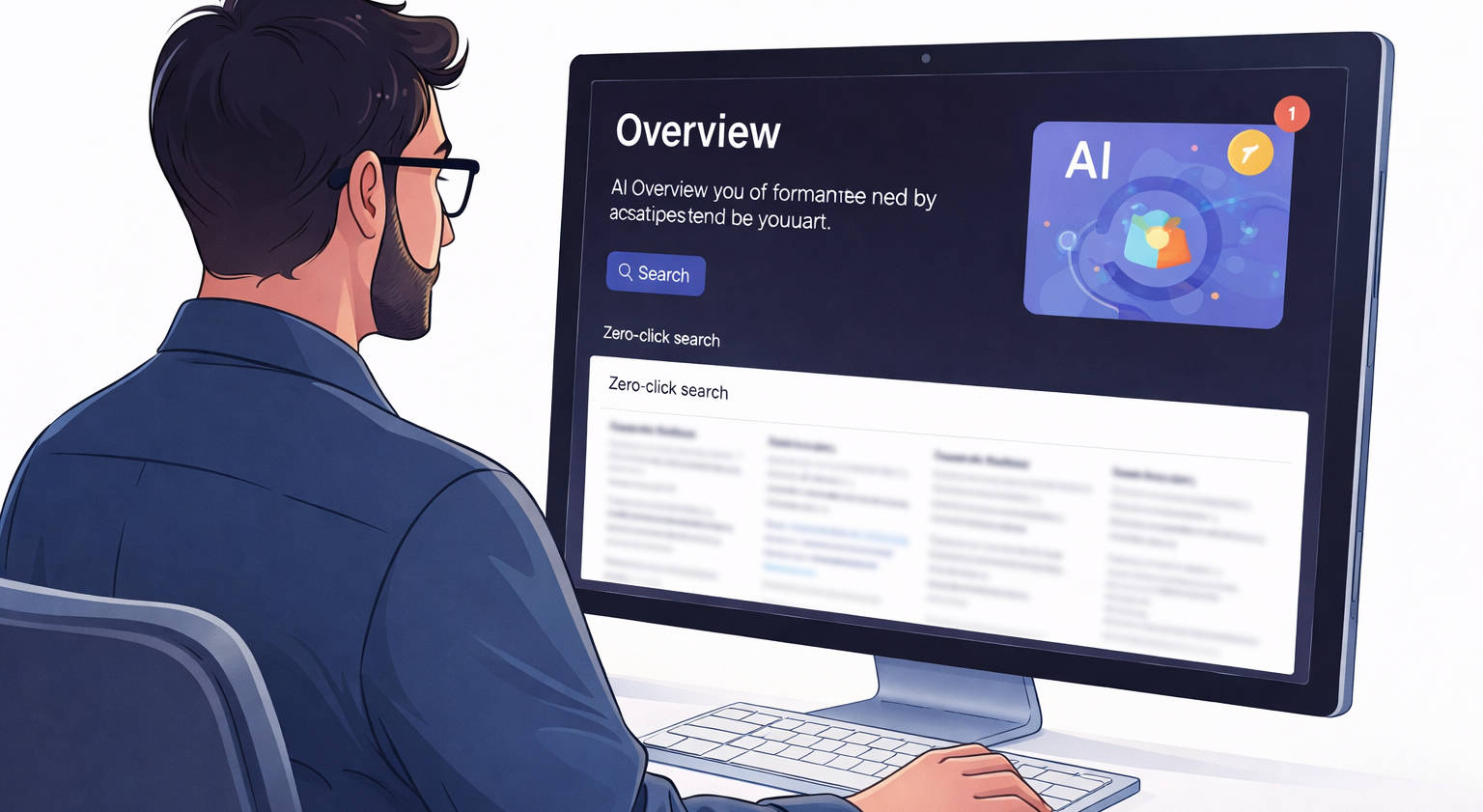
The New North Star: Visibility Quality Over Raw Clicks
For a long time, SEO success was judged by one primary outcome. Did traffic go up?
That lens no longer holds on its own. When AI Overviews reduce the need to click, last-click traffic stops reflecting the full impact of organic visibility. The work is still doing its job. The signal just shows up earlier.
The better question now is not how many clicks you earned, but where and how often your brand appeared when users were seeking answers. Visibility has become the leading indicator, especially during discovery and consideration.
This does not mean clicks stopped mattering. It means they are no longer the only proof of value. Influence happens across the full decision path, not just at the moment of the visit. Search introduces the idea, frames the options, and builds familiarity before a user is ready to act.
In practical terms, SEO success in 2026 looks like:
- Being present on high-intent and high-volume queries, even when clicks are suppressed
- Earning exposure during early research that drives later branded searches
- Supporting conversions indirectly through assisted paths
The shift is subtle but important. Clicks are still an input. Visibility quality is the north star.
Measurement Framework for a Zero Click SERP
This is where the theory turns practical. Measuring SEO in a zero-click environment requires structure, not more metrics. The goal is to separate visibility from traffic and interpret each on its own terms.
Step 1: Segment Queries by AI Overview Likelihood
Not all queries behave the same. Some are far more likely to trigger AI Overviews than others.
Start by grouping queries based on intent patterns:
- Definitions, how-to, and explanations tend to be AI Overview prone
- Comparisons and early research often sit in the middle
- Transactional and navigational queries are least affected
Segmenting this way prevents misleading conclusions from sitewide averages. A falling CTR on informational queries does not mean commercial pages are underperforming.
Step 2: Combine Search Console, Analytics, and Conversions
Each tool tells only part of the story.
Search Console shows exposure and visibility.
Analytics shows behavior and outcomes.
Conversion data shows business impact.
When sessions decline but leads hold steady, the explanation often lives between these systems. This is also where legacy metrics become unreliable in isolation. Sitewide CTR and sessions no longer work as verdicts. They need context.
Step 3: Track Brand Lift as a Supporting Signal
Branded search growth helps explain delayed impact.
Monitor trends in:
- Branded impressions
- Branded clicks
- Direct traffic as directional context
These are not proof of causation. They are supporting evidence. When informational visibility rises and branded demand follows, the narrative becomes clearer without overstating certainty.
What We Still Cannot Measure Cleanly
Some limits remain:
- Direct attribution from AI Overview exposure to later conversions
- Cross-session and cross-device influence with precision
- Citation-level impact beyond impression visibility
Acknowledging these gaps strengthens reporting. Transparency builds confidence. Pretending attribution is cleaner than it is does the opposite.
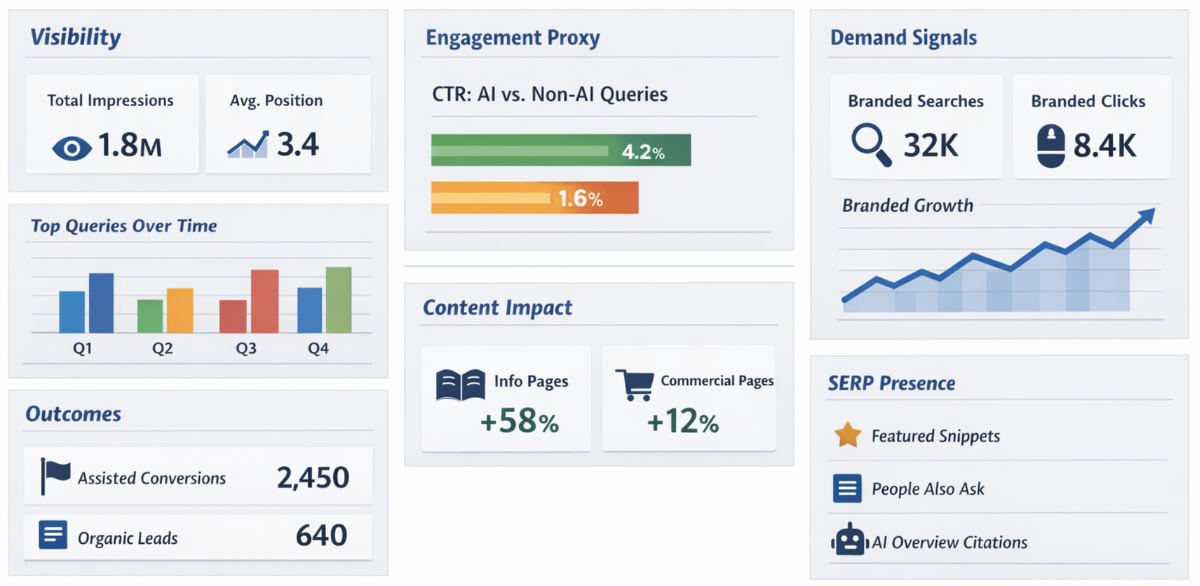
A KPI Dashboard That Actually Makes Sense for 2026
Once measurement shifts away from raw clicks, reporting has to follow. A useful SEO dashboard in 2026 does not chase every metric. It focuses on signals that explain visibility, influence, and outcomes without pretending attribution is perfect.
Think of this as a decision dashboard, not a traffic report.
Visibility
-
Impressions and average position by query group
-
Top queries gaining exposure over time
This answers a simple question. Are you being seen more often where it matters?
Engagement proxy
-
CTR trends segmented by AI Overview likely versus unlikely queries
CTR still has value, but only in context. Segmenting prevents AI-heavy queries from distorting performance reads.
Demand signals
-
Branded impressions and branded clicks
Rising branded demand often reflects earlier informational visibility. This signal helps explain delayed impact without overstating causation.
Outcomes
-
Organic assisted conversions
-
Form fills, calls, purchases tied to organic paths
This keeps reporting grounded in business results, even when sessions flatten.
Content impact
-
Performance of informational pages versus commercial pages
This separation clarifies which content drives discovery and which content closes.
SERP presence
-
Featured snippets
-
People Also Ask visibility
-
AI Overview citations noted through rank tracking or manual review
This captures where attention is earned, not just where links exist.
The point is discipline. CTR and sessions remain inputs, not verdicts. A dashboard like this explains performance clearly, even when traffic charts look uncomfortable.
How These Metrics Change SEO Decisions
Once measurement is framed around visibility and outcomes, decision-making becomes calmer and more precise.
The first shift is where teams invest. Informational content that earns consistent exposure becomes more valuable, not less, even when clicks are suppressed. If those pages support branded demand or assisted conversions, they are doing their job.
The second shift is protection. Commercial pages should be insulated from volatility. Instead of forcing them to compete for AI summaries, they benefit from being supported by informational content that handles discovery and education upstream.
The third shift is restraint. Not every CTR drop needs to be fixed. When visibility is strong and outcomes are stable, chasing click recovery can introduce unnecessary risk without improving results.
This framework also sharpens prioritization:
- Update content based on influence, not just traffic loss
- Protect pages tied directly to revenue
- Accept that some visibility now happens without a visit
The result is focus. SEO decisions move from reaction to intent-aware strategy.
If you want to keep going, the next section addresses how to explain performance drops without sounding defensive, which is often where this conversation gets hardest.
Tactical Plays to Win Visibility When Clicks Are Harder to Earn
When clicks are harder to earn, the goal is not to force them. It is to earn visibility that influences decisions later.
This starts with how pages are structured and where different types of content are asked to compete.
Make Pages Citation-Friendly
AI Overviews pull from content that is easy to summarize and trust.
That usually means:
- Clear, answer-first openings that define the topic quickly
- Short, descriptive subheads that break ideas into chunks
- Simple language that explains without hedging
- Proof elements like examples, steps, or lightweight data
You are not writing for AI. You are writing in a way that AI can accurately represent.
If a page is hard to summarize, it is hard to surface.
Protect Your Money Pages
Commercial pages should not fight for zero-click visibility.
Let informational content handle discovery and education. Use internal links to route interest toward services, products, or comparisons once intent deepens.
This does two things:
- Keeps revenue pages focused on conversion, not explanation
- Uses visibility pages to support the funnel instead of replacing it
The mistake to avoid is forcing every page to do everything. Visibility and conversion play different roles now.
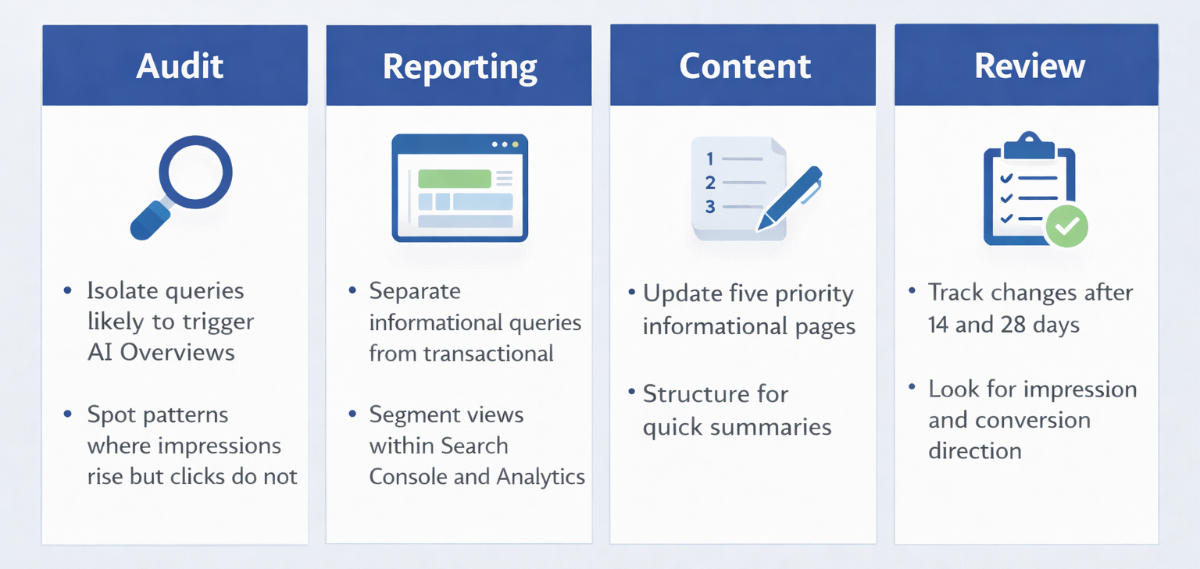
Quick Week 1 Implementation Plan
This does not require a rebuild. It requires focus. The first week is about identifying where AI Overviews are already affecting visibility and adjusting measurement, not chasing instant results.
Audit
Start by isolating queries most likely to trigger AI Overviews. These usually include definitions, how-to topics, comparisons, and early research queries. Look for patterns where impressions are rising but clicks are not.
Reporting
Create segmented views in Search Console and Analytics. Separate informational queries from transactional ones. This single step often explains most CTR confusion without changing any content.
Content
Select five priority informational pages and update them with citation-friendly structure. Clear answer-first openings, tighter subheads, and simple explanations are usually enough.
Review
Evaluate performance directionally after 14 and 28 days. Do not expect clean attribution. Look for changes in impressions, branded demand, and assisted conversions instead of traffic spikes.
The goal of week one is alignment. Once reporting matches reality, decisions get easier.
FAQs
Do AI Overviews reduce clicks for every site?
No. The biggest impact shows up on informational and exploratory queries. High-intent, transactional searches still generate clicks because users need detail, comparison, or a next step.
Can Search Console report AI Overviews separately?
Not today. AI Overview impressions and clicks are included in standard Search Console performance data. There is no dedicated filter or report that isolates AI exposure from traditional results.
What should I tell a client when organic sessions drop?
Explain that visibility moved earlier in the journey. Show impressions, rankings, and conversions together. When outcomes hold steady while clicks soften, the issue is measurement, not performance.
What actually counts as an SEO win in 2026?
Being present when users are researching, influencing demand before they are ready to act, and contributing to conversions, even when traffic does not grow linearly.
Should I update older informational content because of AI Overviews?
Only if it improves clarity. Do not rewrite pages just to chase clicks.
Do AI Overview citations favor large brands?
No. Clear, well-structured answers matter more than brand size.
Closing Perspective
AI Overviews changed how information is surfaced, not what makes content useful.
SEO in 2026 is still about being present when questions are asked, earning trust early, and supporting outcomes later. The difference is that visibility now often happens without a click, and measurement needs to reflect that reality.
This framework is not a finished system. It will evolve as reporting improves and search behavior continues to shift. What matters is clarity. When teams measure influence instead of just traffic, SEO becomes easier to explain, easier to defend, and easier to improve.
The work did not lose value, things have simply changed.