
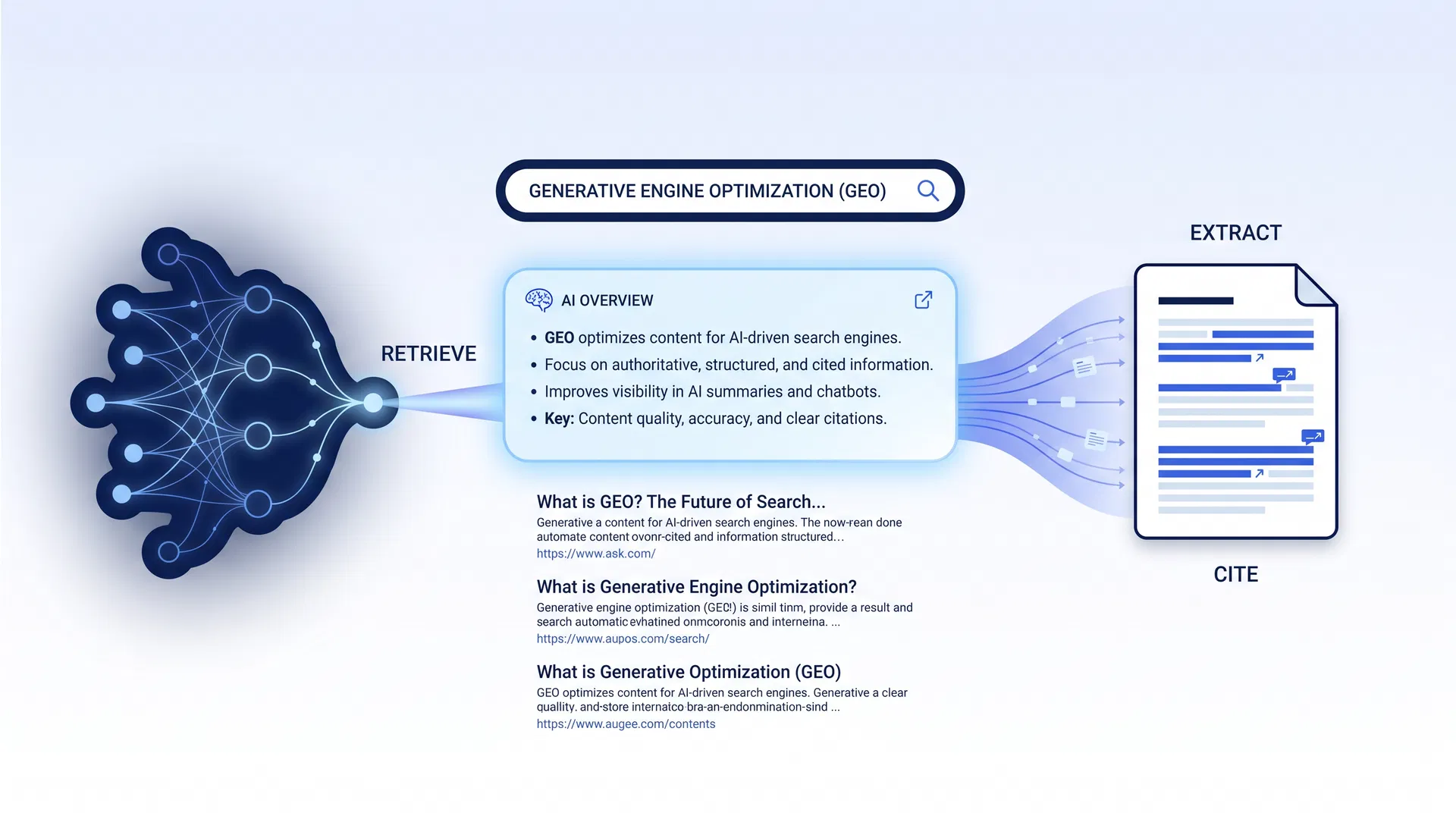
Search is still doing the same core job it always has - helping people find useful information. What has changed is how that information is presented. Instead of sending every user to a list of links, search engines now sometimes generate direct answers. Generative Engine Optimization, or GEO, is simply a way to describe visibility inside those AI generated answers rather than traditional search listings.
58%
of Google searches in 2025 triggered AI Overviews
across informational queries
3.4x
more likely to be cited if content answers directly
vs. broad coverage pages
0
additional ranking signals needed
GEO builds on existing SEO
What's Actually Happening in Search
AI answers sit on top of the existing search ecosystem. They rely on indexed content, established sources, and signals of trust that were already in place. The difference is that instead of ranking pages, the system is selecting information to summarize or reference.
GEO is not about influencing how the model thinks. It is about making your content easy to retrieve, easy to understand, and easy to support when an answer is being assembled. Once that mental model is clear, the rest of the conversation becomes much more practical.
Good to know
GEO is not a new ranking system and it is not a replacement for SEO. It is a visibility outcome - a description of whether your content gets surfaced inside an AI generated answer. Your existing SEO work is the foundation it builds on.
How AI Answers Work at a High Level
Most modern search systems rely on two distinct stages when producing an answer. The first is training - during training, the model learns language patterns, relationships between concepts, and how ideas tend to be explained. The second stage is retrieval - when a real query is entered, the system looks for external information that can support an answer.
Your website is not being trained into the model. Publishing content does not teach the system new facts in real time. Instead, your content becomes eligible to be retrieved if it clearly matches the question being answered and meets basic trust expectations.
"GEO is not about influencing how the model thinks. It is about making your content easy to retrieve, easy to understand, and easy to support."
Why Some Pages Get Cited and Most Don't
The assumption is usually that citations are awarded based on authority alone. Authority matters, but it is not the deciding factor. AI systems are not trying to reward the best website - they are trying to assemble a usable answer. Pages that get cited tend to share three traits.
They answer a specific question directly
AI systems favor content that resolves a question quickly and clearly. Pages that explain one concept cleanly are easier to extract from than pages that cover several related ideas without fully answering any of them. If the answer has to be inferred or pieced together, the page becomes less useful in a retrieval context.
They stay focused on one topic
Topical focus matters more for AI answers than it does for traditional rankings. A page that is clearly about one idea, process, or definition is easier to evaluate and easier to reference. Pages that mix multiple intents can still rank well, but they are harder to summarize accurately.
They use consistent terminology
AI systems rely on language patterns and entity relationships. When the same concept is described using vague phrasing or inconsistent names, it introduces ambiguity. Pages that use clear, stable terminology reduce that ambiguity and are easier to trust as supporting sources.
What GEO Changes About Content Strategy
Traditional SEO rewarded breadth. Pages were often designed to rank for a wide set of related keywords, cover multiple subtopics, and capture as much surface area as possible. That approach still works for rankings, but it does not translate cleanly to AI generated answers. AI systems are not trying to understand everything on a page - they are trying to resolve a specific question.
Coverage-first strategy
- "What keywords should this page rank for?"
- Long pages covering many related subtopics
- Creative, teaser-style headings
- Answer buried under context and qualifiers
Clarity-first strategy
- "What question should this page answer?"
- Focused pages, each with one clear purpose
- Literal, descriptive headings
- Answer stated first, then explained
The answer-first rule
Instead of building toward a conclusion, state the conclusion clearly and then explain it. This makes the core idea visible immediately, both to readers and to retrieval systems. Pages that do this well tend to be easier to summarize, easier to quote, and easier to reference inside AI generated answers.
What You Cannot Control in GEO and AI Overviews
One of the fastest ways to waste time with GEO is assuming it behaves like traditional SEO. AI generated answers introduce uncertainty by design. Understanding what sits outside your control helps prevent over-optimization and keeps effort focused where it actually matters.
Watch out
Citations are not permanent. AI systems test different sources, rotate references, and adjust based on performance signals. A page that is cited today may disappear tomorrow without any change on your end. Treat GEO visibility as probabilistic, not guaranteed - and never make it a primary KPI.
Factors outside your control
Whether a query is considered suitable for an AI generated response
How confident the system is in available sources at query time
Whether a traditional result is deemed sufficient without AI
Which sources are rotated in or out of citation pools
How different AI search engines weight your domain
How GEO Fits Into Existing SEO Work
GEO is best understood as a visibility outcome that depends on strong SEO foundations. SEO determines whether your content is eligible to be considered. GEO determines whether that content is selected and reused inside an AI generated answer.
| SEO Foundation | What It Controls | How GEO Builds on It |
|---|---|---|
| Technical SEO | Crawlability, indexability, page access | Determines whether content can be retrieved by AI systems |
| Site Structure | Context, hierarchy, topical relationships | Helps AI understand page purpose and reduce ambiguity |
| Authority & Brand Signals | Trust, reputation, source reliability | Influences whether a source is considered safe to reference |
| Content Quality | Clarity, accuracy, usefulness for users | Improves how easily information can be extracted into AI answers |
Practical Guidance Without Overpromising
Once GEO is understood as a byproduct of good SEO and clear content, the question becomes practical. What should you actually do differently? The answer is less dramatic than most advice makes it sound. You do not need a new playbook - you need better discipline around how content is written, structured, and maintained.
Pro tip
The easiest place to apply GEO thinking is not new content - it is existing pages that already receive impressions, traffic, or rankings. These pages already meet basic eligibility requirements. The work is in making them easier to understand and easier to extract from.
Four quick improvements for existing pages
Clarify what the page is about in the opening section
State the topic, the question being answered, and the structure within the first two paragraphs. Ambiguity works against retrieval.
Add direct answers to questions the page implies but never states
Scan your headings. If any heading asks a question, make sure the first sentence after it answers it directly - not in the third paragraph.
Tighten headings so they describe what follows
Replace clever or teaser headings with literal descriptions. "Why Citations Disappear" is clearer than "The Surprising Truth About AI Visibility."
Remove sections that exist only to pad coverage
If a section does not add a new idea or answer a new question, cut it. Shorter, focused pages are easier to extract from than long, padded ones.
How to Think About GEO Going Forward
GEO feels new because the interface of search is changing. The underlying problem is not. People still want clear answers. Search engines still want reliable sources. The difference is that the explanation layer now sits closer to the user.
The safest way to think about GEO is not as a tactic, a channel, or a system to chase. It is a reflection of how understandable your content is when someone - or something - needs to explain it. AI systems surface content that reduces uncertainty. They favor explanations that can stand on their own, use consistent language, and do not require interpretation.
GEO does not require you to predict how search will look next year. It rewards doing the basics well today and doing them consistently. When content is written to explain rather than perform, visibility tends to follow in whatever format search takes next.
"Clarity is the durable advantage."
Key Takeaways
GEO is a visibility outcome, not a separate ranking system. It builds on SEO fundamentals.
AI answers use a retrieval stage - your content must be indexed and clearly structured to be eligible.
Pages get cited because they are easy to extract from, not because they are the most authoritative.
Clarity-first content - answer stated before explanation - performs better in both human and AI contexts.
You cannot control when AI answers appear or which sources are cited. Focus on inputs you can evaluate.
GEO visibility should be treated as a secondary signal, not a primary KPI.
Frequently Asked Questions
Ready to optimize for GEO?
RankPilot scores your content on clarity, focus, and extractability - the three signals that drive AI citations.