
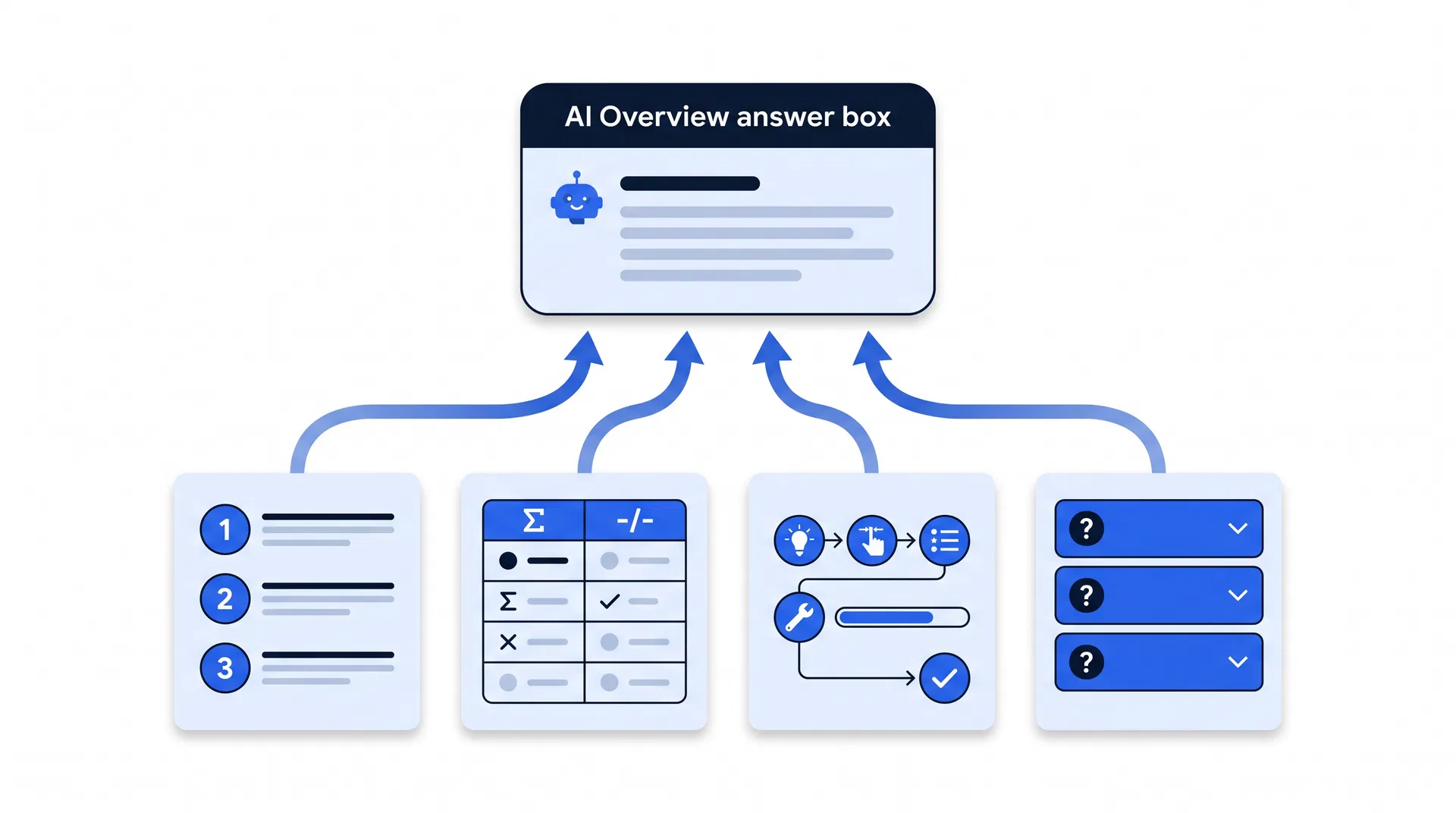
Not all content is equally likely to appear in Google AI Overviews. The format of your content - how it is structured, how answers are presented, how clearly it signals its own organization - has a measurable impact on whether Google's AI system extracts and cites it. This is not about gaming the algorithm. It is about understanding how AI systems consume and summarize content, and structuring your writing to make that process as easy as possible.
This guide covers the specific content formats that appear most frequently in AI Overviews, why they work, and how to implement them in your existing content without a full rewrite.
46%
Of AI Overview citations
come from pages not in the top 10 organic results
3x
More likely to be cited
content with clear answer-first structure vs. buried answers
68%
Of AI Overviews
include at least one structured format (list, table, or steps)
Why Format Matters for AI Citation
Google's AI Overview system works by retrieving candidate passages from multiple sources, extracting the most relevant information, and synthesizing it into a coherent answer. The extraction step is where format matters most. Content that is clearly structured - with explicit headings, defined answer units, and logical organization - is easier to extract accurately than content buried in long paragraphs.
This is closely related to the principles behind generative engine optimization: making your content machine-readable is not about keyword stuffing, it is about structural clarity. The AI does not read your content the way a human does. It identifies answer-shaped passages and evaluates their relevance to the query.
The Six Formats That Appear Most Often in AI Overviews
Direct answer paragraphs
A single paragraph that opens with a direct answer to a specific question, then provides supporting context. The answer comes first, the explanation follows. This mirrors how AI Overviews are structured and makes extraction straightforward. Ideal for definition queries, 'what is' questions, and factual lookups.
Numbered step sequences
Step-by-step processes with numbered headings and a clear action in each step. AI systems extract these reliably because the structure is unambiguous - each numbered item is a discrete, complete unit of information. Works best for how-to content, tutorials, and process explanations.
Comparison tables
Two or three column tables that directly compare options, features, or approaches. Tables are highly extractable because they present structured relationships between entities. AI Overviews frequently cite comparison tables for 'X vs Y' and 'best X for Y' queries.
FAQ sections with direct answers
Question-and-answer pairs where each answer is self-contained and begins with a direct response. The question provides the query context, the answer provides the citation content. FAQ sections are disproportionately cited in AI Overviews relative to their length because each Q&A pair is a pre-packaged answer unit.
Definition blocks
A clearly demarcated definition or explanation of a term or concept, often set apart visually with a border or background. When a query is definitional ('what is X'), Google preferentially cites content that has a clear, concise definition rather than a definition buried in flowing prose.
Bulleted attribute lists
Lists of characteristics, features, requirements, or attributes with brief explanations for each item. Works well for 'what are the X of Y' queries and 'how does X work' queries where the answer is a set of components rather than a single statement.
Format by Query Type: A Practical Mapping
| Query Type | Example | Best Format | Why It Works |
|---|---|---|---|
| Definition | What is schema markup? | Direct answer paragraph | AI extracts the opening sentence as the answer |
| How-to | How to set up Google Search Console | Numbered steps | Each step is a discrete, extractable unit |
| Comparison | Ahrefs vs Semrush for keyword research | Comparison table | Structured relationships are easy to extract |
| Best of | Best SEO tools for small businesses | Bulleted list with descriptions | Each item is a self-contained recommendation |
| Factual | How many backlinks do I need to rank? | Direct answer + supporting context | Specific answer first, nuance second |
| Process | How does Google index a new page? | Numbered steps or flow description | Sequential structure matches the query intent |
| FAQ | Is Keyword Planner free? | FAQ section with direct answers | Pre-packaged Q&A pairs match the query format |
“The question to ask for every section of your content is: if an AI system needed to extract a one-sentence answer to a specific question from this section, could it? If the answer is buried in a paragraph, restructure it.”
A practical test for AI-extractable content structure
How to Audit Your Existing Content for Format Gaps
You do not need to rewrite your entire content library to improve AI Overview citation rates. A targeted audit focused on your highest-traffic pages will produce the most impact with the least effort. This is the same principle behind the 90-minute content audit framework - identify the pages with the most potential and focus your optimization effort there first.
For each high-traffic page, ask three questions: Does the page have a direct answer to its primary query in the first 100 words? Does the page use at least one structured format (list, table, or steps)? Does the page have an FAQ section that addresses common follow-up questions? Pages that answer "no" to all three are your highest-priority format optimization targets.
The connection between content format and AI Overview performance is one of the key insights driving how RankPilot is used by content teams who are actively tracking their AI Overview appearances and optimizing for citation rather than just ranking position.
Structure your content to get cited by AI.
RankPilot helps you identify which content formats are working for your competitors in AI Overviews and gives you the workflow to replicate and improve on them.
Start Free TrialKey Takeaways
- 46% of AI Overview citations come from pages not in the top 10 organic results - format optimization can surface content that keyword optimization alone cannot.
- The six most-cited formats are: direct answer paragraphs, numbered steps, comparison tables, FAQ sections, definition blocks, and bulleted attribute lists.
- Combining multiple formats within a single article targets multiple query types and increases the surface area for AI citation.
- A practical audit test: for each section, ask whether an AI system could extract a one-sentence answer to a specific question. If not, restructure.
- FAQ sections sourced from 'People Also Ask' boxes are the fastest way to add AI-extractable content to existing pages without a full rewrite.
Frequently Asked Questions